
“Heads Must Roll”: Supreme Court Bans NCERT Book Over Controversial Judiciary Chapter
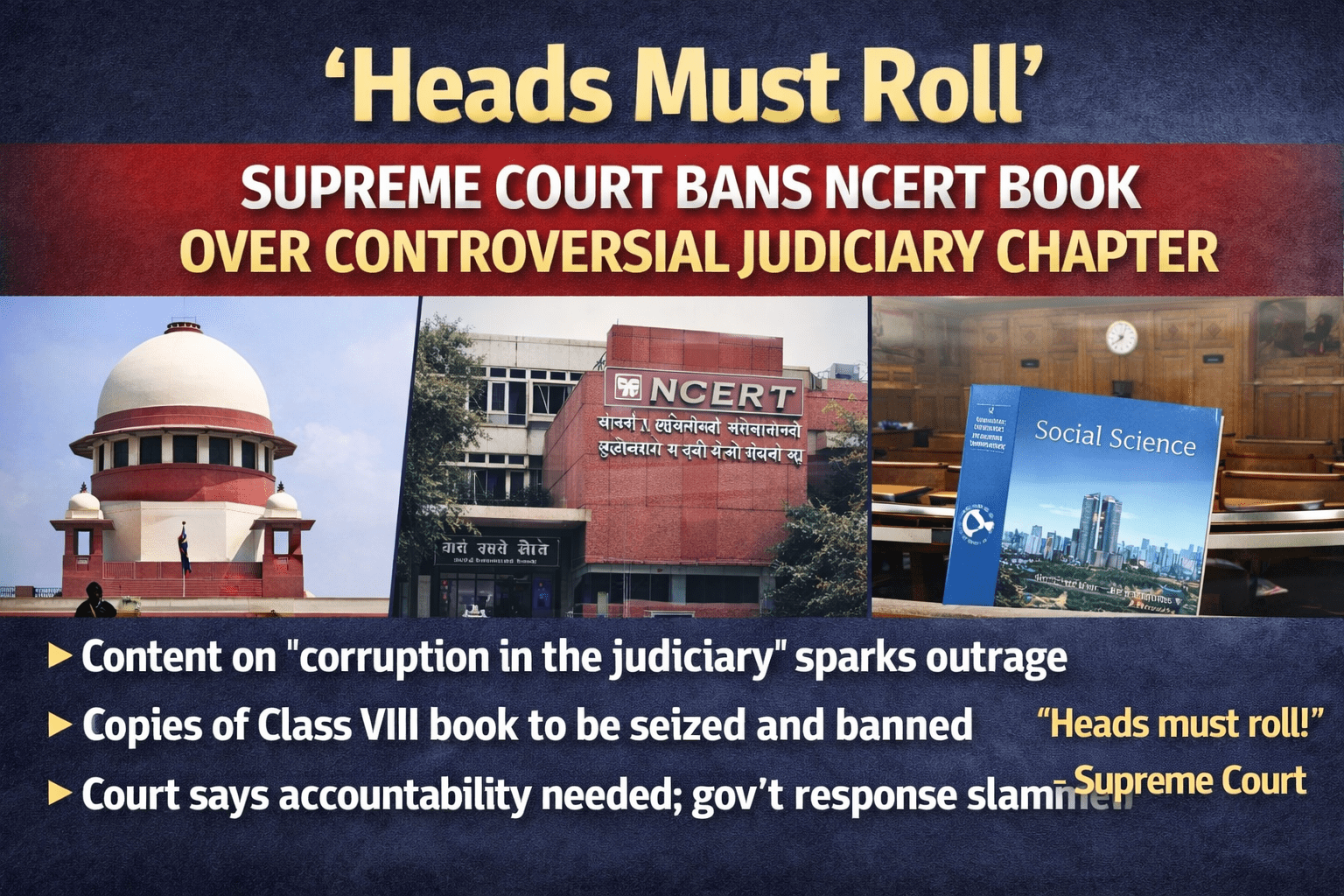
In a strongly worded order, the Supreme Court of India on Thursday banned a Class VIII Social Science textbook published by the National Council of Educational Research and Training (NCERT), citing serious concerns over references to “corruption in the judiciary.”
A bench led by Chief Justice Surya Kant expressed outrage over the content of the chapter titled “The Role of the Judiciary in Our Society” and warned that accountability must be fixed.
“We would like to have a deeper probe. We need to find out who is responsible… heads must roll! We won’t close the case,” the court observed while questioning Solicitor General Tushar Mehta, who appeared for the NCERT.
Blanket Ban and Seizure Ordered
The court ordered an immediate ban on the textbook in India and abroad, directing authorities to seize all available copies. It also imposed a blanket prohibition on sharing the book, in whole or in part, online.
Notices were issued to the Centre and NCERT Chairman Professor Dinesh Prasad Saklani, seeking explanations regarding the inclusion of the contentious material.
Court Slams Government’s Response
During the hearing, Solicitor General Tushar Mehta informed the court that two individuals responsible for including the reference to “corruption in the judiciary” would no longer work with the UGC or any ministry.
“We stand by the institution. No one will get away scot-free,” Mehta told the bench.
However, the Chief Justice expressed dissatisfaction with this response.
“That is of very little consequence. They fired gunshot and judiciary is bleeding today. This looks like a deep-rooted conspiracy. A very calculated move,” he remarked sharply.
The bench also questioned an NCERT press release that described the inclusion of “inappropriate textual material” as an inadvertent error and expressed “regret.” The Chief Justice noted that the statement lacked a clear and unconditional apology.
Books Still in Circulation
The court was informed that 32 copies of the book had entered the market but had since been withdrawn. However, the Chief Justice pointed out that the book was still available.
“It’s available in the market… I got a copy from sources,” he said.
Mehta assured the court that the entire chapter would be revised and removed.
Government’s Position
Earlier, high-level government sources had indicated that references to “corruption in the judiciary” would be deleted, stating that “inspirational things should have been written” instead.
The development came after the Supreme Court expressed “grave concern” over the matter, noting that members of the judiciary, including High Court judges, were “perturbed” by the references.
What the Chapter Contained
The revised chapter went beyond explaining the structure and hierarchy of courts. It discussed challenges such as case backlogs and corruption at various levels, while also referring to judicial accountability mechanisms and efforts to enhance transparency through technology.
The book mentioned the principle “justice delayed is justice denied,” which also drew strong objections during the hearing.
Legal Community Reacts
Senior advocate Sidhart Luthra questioned whether school-level education should include material that might “complicate” rather than educate young minds. He argued that at the Class VIII level, textbooks should focus on explaining the structure and functions of governance institutions.
Supreme Court lawyer Pragya Parijat Singh said that mentioning corruption without critical analysis reflected a lack of contextual understanding.
“Judiciary has always endeavoured to strengthen democracy. To mention such issues without deeper explanation shows lack of balance,” she said.
Suo Motu Action Likely
Chief Justice Surya Kant indicated that the court has taken cognisance of the issue and may initiate suo motu proceedings to examine the matter further.
The case has sparked a wider debate over how institutions, particularly the judiciary, should be represented in school curricula — balancing transparency and accountability with respect for constitutional bodies.
Further hearings in the matter are expected soon.