


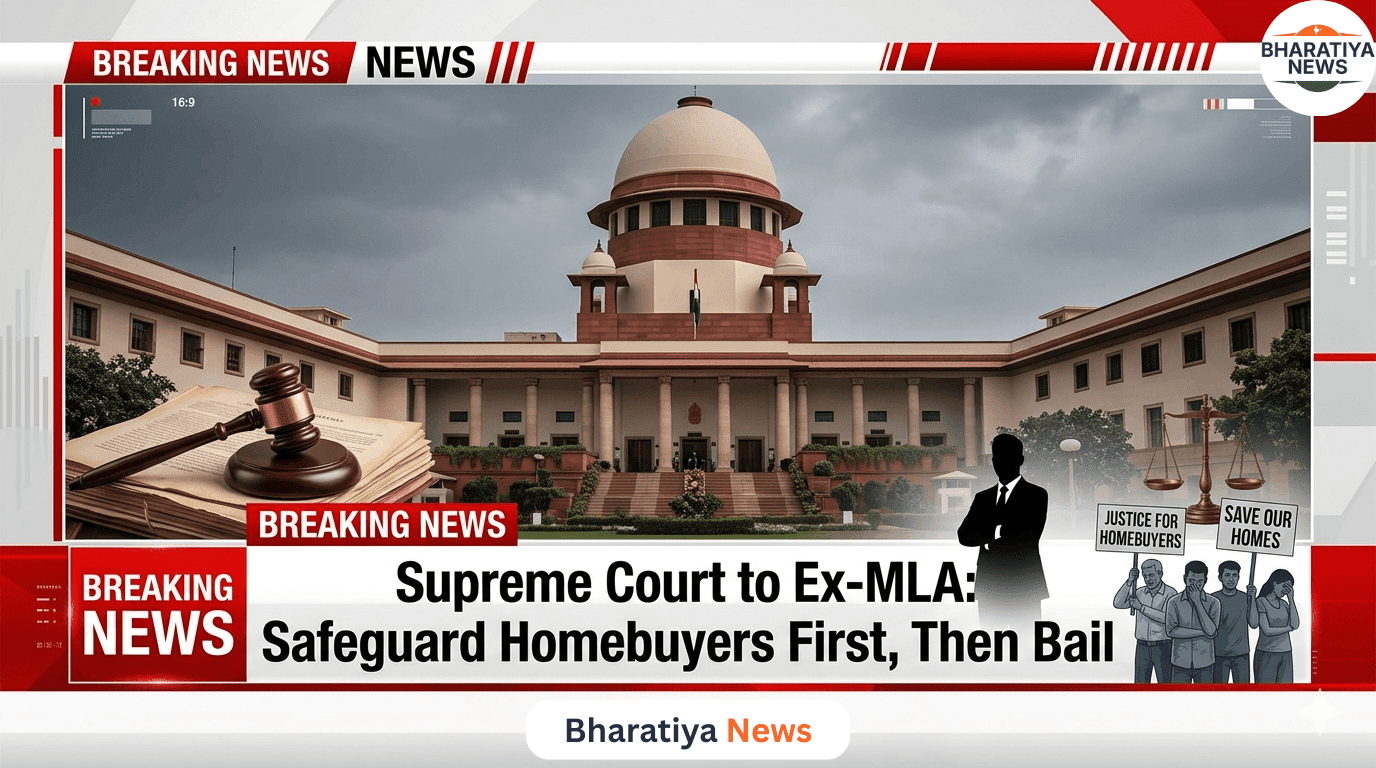
Supreme Court to Ex-MLA: Safeguard Homebuyers First, Then Seek Bail in Money Laundering Case
Supreme Court Seeks Justification Before Considering Bail
In a significant development, the Supreme Court of India has asked former MLA Dharam Singh Chhoker to explain why his bail plea should be considered without first safeguarding the interests of homebuyers allegedly duped in a housing project-linked money laundering case.
The Court observed:
“Unless the petitioner safeguards the interest of homebuyers, who have been ex-facie duped, let the petitioner show cause as to why this Court should entertain the prayer in this petition.”
Background of the Case
The matter relates to an affordable housing project undertaken by a company under the Mahira Group, controlled by Chhoker and his family. Authorities have alleged that funds collected from homebuyers were diverted and misused.
According to the allegations:
- Funds amounting to approximately ₹616 crore were siphoned off
- The money was allegedly laundered through multiple channels
- Homebuyers were left without the promised housing units
High Court Had Denied Bail
Earlier, the Punjab and Haryana High Court had denied regular bail to Dharam Singh Chhoker, citing:
- Serious nature of allegations
- Evidence collected during investigation
- Ongoing probe into financial transactions
The High Court had concluded that the material on record did not justify granting bail at that stage.
Supreme Court Bench Observations
A bench comprising Chief Justice Surya Kant and Justice Joymalya Bagchi examined the matter and noted several key points:
- The accused was associated with multiple companies involved in the project
- He was actively engaged in company affairs, including signing financial documents
- Funds collected from buyers were allegedly used for purposes unrelated to construction
The Court also highlighted concerns regarding the conduct of the accused during the investigation.
Non-Compliance and Arrest Details
The Court took note of multiple instances where:
- The accused failed to respond to investigation summons
- Non-bailable warrants had to be issued
- He was not found at his residence during attempts to arrest him
It was further recorded that he was eventually apprehended in Delhi after allegedly attempting to evade arrest.
Enforcement Directorate’s Stand
The Enforcement Directorate opposed the bail plea, citing:
- Seriousness of the financial crime
- Conduct of the accused during investigation
- Legal conditions under the Prevention of Money Laundering Act (PMLA)
The agency argued that the statutory requirements for granting bail had not been fulfilled.
No Relief on Grounds of Parity
The Court also rejected the argument that bail should be granted on parity with a co-accused who had secured relief earlier. It noted that the order granting bail to the co-accused was itself under challenge and could not be used as a precedent.
Case Details
Case Title: Dharam Singh Chhoker vs Directorate of Enforcement
Case Number: SLP (Crl) No. 7383/2026
Conclusion
The Supreme Court of India has made it clear that the protection of homebuyers’ interests will be a key consideration before any relief is granted to Dharam Singh Chhoker. The case highlights the judiciary’s strict stance on financial irregularities and accountability in housing projects.
Disclaimer
This article is based on publicly available information and court proceedings as reported by various sources. While efforts have been made to ensure accuracy, bharatiyanews.net does not independently verify all claims. The website shall not be held responsible for any errors, omissions, or subsequent developments. Readers are advised to refer to official court records and statements for complete and verified information.