



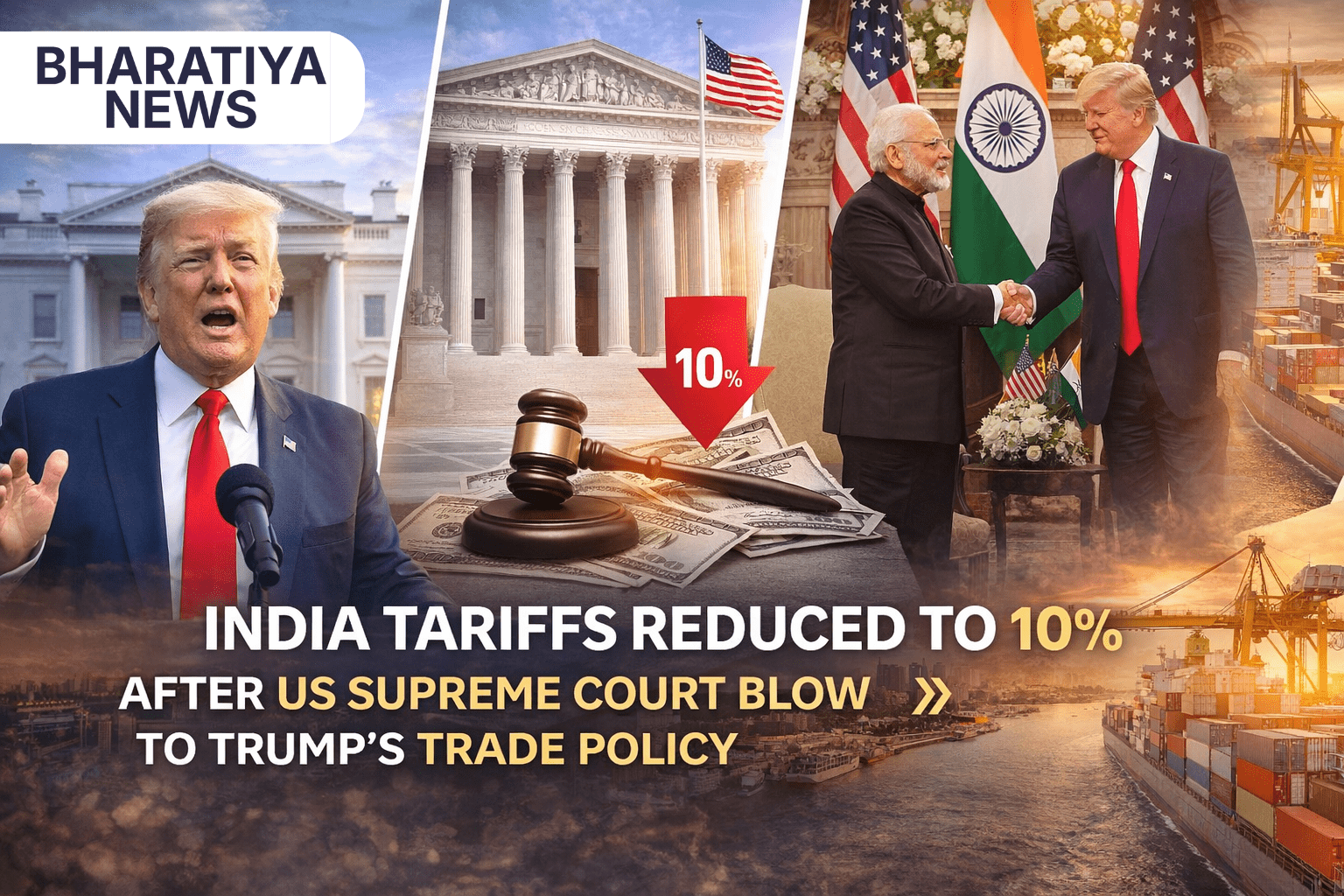
India Tariffs Reduced to 10% After US Supreme Court Blow to Trump’s Trade Policy
Washington:
India will now face a uniform import tariff of 10 per cent on goods entering the United States, a reduction from the earlier 18 per cent, after a major setback to former US President Donald Trump at the US Supreme Court. The ruling curtailed the legal basis of Trump’s sweeping tariff regime, prompting the White House to quickly introduce a new global levy.
The revised tariff was announced shortly after the Supreme Court ruled against Trump’s use of emergency economic powers to impose unilateral duties on multiple countries. Trump subsequently signed a fresh order imposing a flat 10 per cent duty on imports from all trading partners, including India. The new tariff will come into force on February 24 and will remain valid for 150 days, according to a White House factsheet.
New Tariff Framework Explained
The latest duties have been imposed under Section 122 of the Trade Act of 1974, which allows the US President to temporarily levy tariffs of up to 15 per cent for a maximum of 150 days to address serious balance-of-payments concerns. Unlike the earlier framework, the new order applies uniformly across countries.
Certain categories remain exempt, including pharmaceuticals under separate investigations and goods entering the US under the US–Mexico–Canada Agreement (USMCA).
Impact on India-US Trade
The decision effectively overrides the interim trade framework announced earlier this month between India and the United States, under which Indian exports were to face an 18 per cent tariff. With the new global levy in place, Indian goods will now be charged only 10 per cent, easing pressure on exporters.
A White House official indicated that the administration may later explore ways to reinstate pre-negotiated or country-specific tariff rates. However, unless extended by Congress, the Section 122 tariffs will automatically expire after 150 days.
Trump Insists Trade Deals Are Intact
Speaking after the court verdict, Trump said the India–US trade deal remains unaffected despite the legal setback.
“My relationship with India is fantastic, and we’re doing trade with India,” he said, adding that tariffs would continue to be part of US trade arrangements. “Nothing changes. The deals are on — we’re just doing it in a different way.”
Supreme Court Verdict and Its Fallout
In a 6–3 ruling, the Supreme Court held that the International Emergency Economic Powers Act (IEEPA) does not authorise the President to impose tariffs during peacetime. Chief Justice John Roberts noted that the law contains no reference to tariffs and that Congress would have explicitly granted such powers if intended.
The judgment marked Trump’s most significant legal defeat since returning to the White House, even as the court has otherwise expanded executive authority in several areas. The ruling does not affect sector-specific tariffs on steel, aluminium, and other goods imposed under separate statutes.
Markets and Businesses React
US markets responded positively, with Wall Street recording modest gains. Business groups welcomed the verdict, citing greater certainty for global trade. However, questions remain over refunds for tariffs already paid. While earlier court arguments suggested refunds could be issued, the ruling did not settle the matter.
Economic models estimate potential refunds could run into hundreds of billions of dollars, though senior lawmakers have warned that consumers and small businesses may struggle to recover past payments.
What Lies Ahead
With the new 10 per cent tariff now in place, India and other US trading partners will closely watch whether Congress extends the measure or allows it to lapse. For now, the reduced duty offers temporary relief to Indian exporters while keeping broader trade negotiations between New Delhi and Washington on track.
