


Supreme Court’s Aravalli Definition Sparks Controversy: What It Means for Environmental Protection
New Delhi
The debate over how India defines and protects the Aravalli mountain range has once again reached the Supreme Court, drawing widespread attention from environmentalists, political leaders, and local communities.
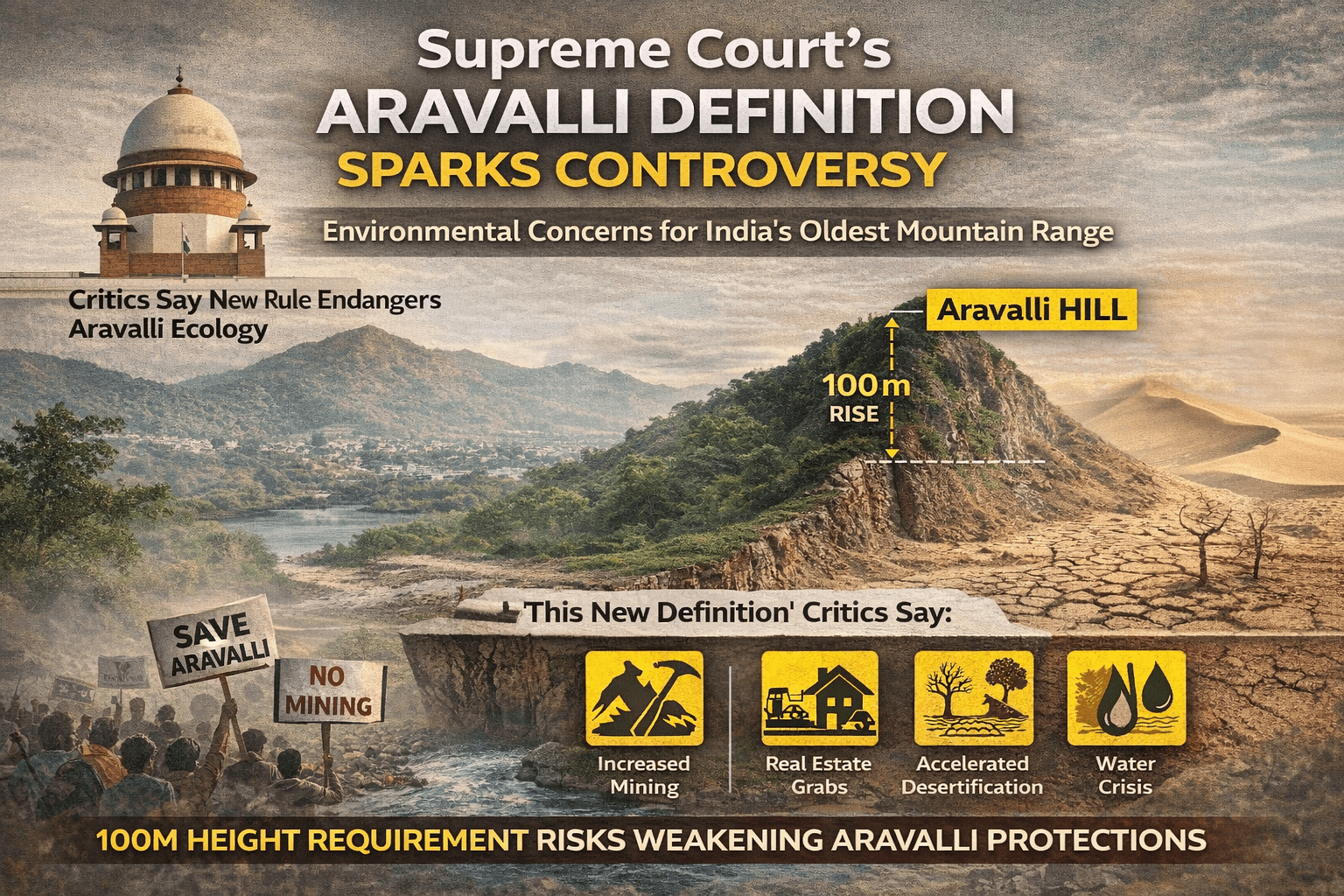
At the centre of the dispute is a novel legal definition accepted by the Supreme Court on 20 November 2025, which aims to standardize how the Aravalli Hills and Range are identified across Delhi, Haryana, Rajasthan, and Gujarat. Under this framework, only certain landforms qualify for ecological safeguards, a move that has triggered protests and legal challenges nationwide. Jagranjosh.com+1
What is the New Aravalli Definition?
According to the Supreme Court’s 2025 ruling and the technical framework proposed by a Union Environment Ministry-led committee:
- An “Aravalli Hill” is defined as any landform in designated Aravalli districts that rises at least 100 metres above local relief — meaning the difference in elevation between the hill’s peak and its immediate surrounding ground level. Jagranjosh.com
- An “Aravalli Range” consists of two or more such hills within 500 metres of each other. Jagranjosh.com
The criteria aim to offer a consistent, science-based classification across states that previously used differing definitions. Jagranjosh.com
Why the Definition Matters
This legal definition determines which areas receive environmental protection, including safeguards against mining, deforestation, and unregulated development.
Government officials maintain that the ruling will not weaken protections. According to the Union Environment Minister, over 90% of the 1.44-1.47 lakh sq km Aravalli landscape remains protected under the new criteria. The minister reiterated that no general relaxation for mining has been introduced and that strict oversight will continue in core and eco-sensitive zones. The Economic Times+1
Under the current framework:
- Mining and new leases are prohibited in core environmental zones, protected forests, wildlife sanctuaries, eco-sensitive zones, tiger reserves and wetlands. The New Indian Express
- The Supreme Court also directed authorities to prepare a comprehensive scientific management plan before considering any regulated mining, further restricting activity until that is complete. The New Indian Express
Environmentalists Raise Red Flags
Environmental advocates, scientists, and legal experts argue that the 100-metre threshold may inadvertently exclude many ecologically vital parts of the Aravalli system — particularly smaller ridges, foothills, and slopes that are below the elevation cut-off but provide key environmental services. The New Indian Express
Critics point out that:
- Lower hills and gentle slopes act as groundwater recharge zones, maintain soil stability, and help support biodiversity. The New Indian Express
- These features have historically helped regulate air quality and reduced the spread of desertification from western India into the northern plains, contributing to more stable local climates. The Times of India
Further, multiple environmental groups and leaders have warned that excluding such regions from legal protection could open them up to mining, real estate development, and other disruptive activities with long-term ecological consequences. The New Indian Express
Public Response and Legal Action
The revised definition has prompted a wave of street protests in places such as Udaipur, Jaipur, and Kotputli, where residents and activists have voiced opposition. Demonstrators argue the old, forest-survey-based definition provided broader environmental coverage that better matched the landscape’s actual ecological role. NewsGram+1
Meanwhile, legal petitions challenging the Supreme Court-endorsed criteria have been admitted for hearing. Petitioners contend the strict elevation rule could weaken crucial protections, affecting biodiversity, water security, and environmental sustainability across the Aravalli region. The Times of India
Why the Aravallis Matter
The Aravalli range is one of the oldest fold mountain systems in the world, stretching from Delhi and Haryana through Rajasthan, into parts of Gujarat. It plays a vital role in the region’s ecology by:
- Regulating seasonal weather patterns
- Acting as a natural barrier against sandstorms and dust intrusion from desert areas
- Supporting groundwater recharge and crucial aquifers
Any perceived reduction in protections has raised concerns about future impacts on air quality, water security, and ecosystem resilience, especially in the Delhi-NCR region. NewsGram
Conclusion
The Aravalli issue reflects a broader environmental policy challenge — balancing uniform legal definitions and enforcement with the complex realities of ecological systems. While the Supreme Court and government maintain that most of the mountain range is still protected, critics argue the new criteria fail to account for the ecological importance of lower elevation features that underpin regional environmental health.
As the matter progresses through legal and public forums, the resolution of this debate will influence environmental governance and natural resource protection across northern India in the years to come.