


India–EU Trade Pact Nears Final Stage, European Commission Chief Calls It a “Historic Deal”
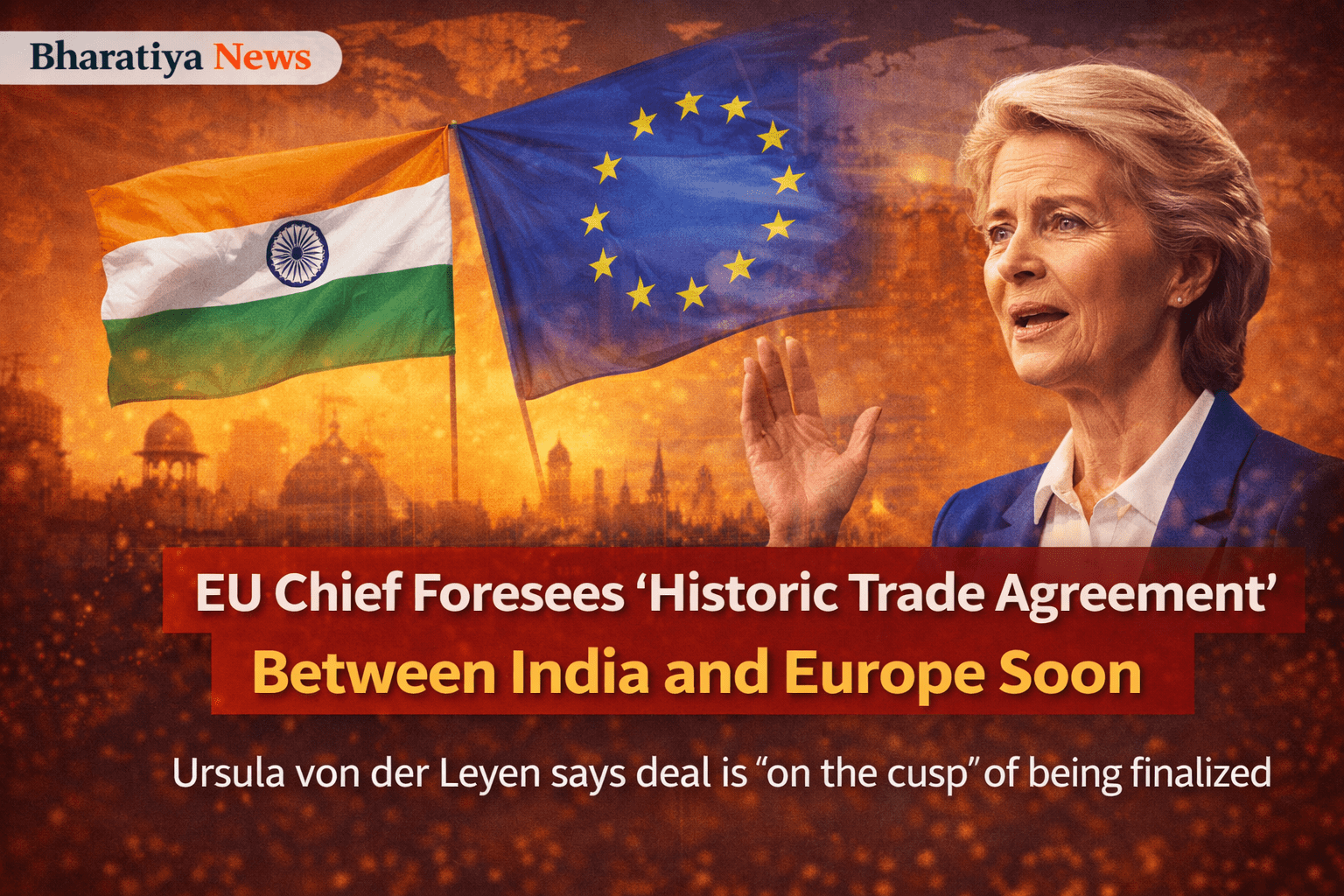
India and the European Union are close to finalising a long-awaited free trade agreement that could significantly reshape global commerce, European Commission President Ursula von der Leyen said on Tuesday. Describing the proposed pact as a “historic trade agreement,” she stated that negotiations have reached an advanced stage and that the deal could be concluded in the near future.
Speaking at the World Economic Forum in Davos, von der Leyen said the European Union is “on the cusp” of sealing what has been termed by many as the “mother of all trade deals.” The agreement, once signed, would create a massive integrated market of nearly two billion people and represent almost one-fourth of global GDP, giving the EU a strategic first-mover advantage in one of the world’s fastest-growing economies.
The development comes at a time when global trade dynamics are under pressure. India’s trade negotiations with the United States remain uncertain, while renewed tariff threats from the US — including proposed duties linked to geopolitical disputes over Greenland — have added to global economic uncertainty. India has also faced elevated tariffs on certain exports since last year, prompting policymakers to diversify trade partnerships.
Von der Leyen announced that she would be travelling to India shortly after the Davos summit, underlining the urgency and importance of the negotiations. She emphasized that Europe is keen to deepen economic engagement with emerging growth centres, particularly in the Indo-Pacific region. Stressing Europe’s commitment to open and rules-based trade, she said the EU is prepared to strengthen partnerships with countries that support economic cooperation and stability.
Both von der Leyen and European Council President Antonio Luís Santos da Costa are scheduled to be the chief guests at India’s Republic Day celebrations next week. During their visit, they will also co-chair the 16th India–EU Summit on January 27, where the trade agreement is expected to be a key focus.
India’s Commerce Minister Piyush Goyal has also expressed strong optimism about the deal, earlier calling it a comprehensive and balanced agreement that addresses the sensitivities of both sides. According to officials, the pact is designed to enhance trade, investment, and technology cooperation while ensuring mutual economic benefits.
Negotiations for the India–EU trade agreement have been ongoing for nearly two decades. Talks initially began in 2007 but were suspended in 2013 due to differences over market access and regulatory standards. The dialogue was revived in July 2022 amid changing global trade conditions and renewed interest from both sides in reducing dependence on traditional markets.
A major driver behind the renewed momentum is the evolving global supply chain landscape and shared concerns over China’s dominance in key manufacturing sectors. European policymakers have voiced apprehensions about over-reliance on Chinese supply chains, especially in critical technologies, while Indian industries are seeking support to scale up sectors such as renewable energy and manufacturing.
Under the proposed agreement, India is aiming to secure greater access to European markets for labour-intensive sectors such as textiles, footwear, gems, jewellery, and handicrafts. In return, the European Union is expected to seek improved market access for automobiles, premium beverages, and advanced industrial goods.
Commerce Secretary Rajesh Agarwal recently stated that substantial progress has been made, with consensus reached on nearly 20 out of the 24 negotiation chapters. He added that both sides are working intensively to resolve remaining issues before the upcoming high-level visits.
If finalised, the India–EU trade agreement is expected to deepen strategic ties, boost bilateral trade, attract investment, and create new opportunities for businesses on both sides. Analysts believe the deal could mark a turning point in India’s global trade strategy and strengthen Europe’s economic engagement with Asia in an increasingly multipolar world.
(Except for the headline, this story has not been edited by Bharatiya News staff and is published from a syndicated feed.)